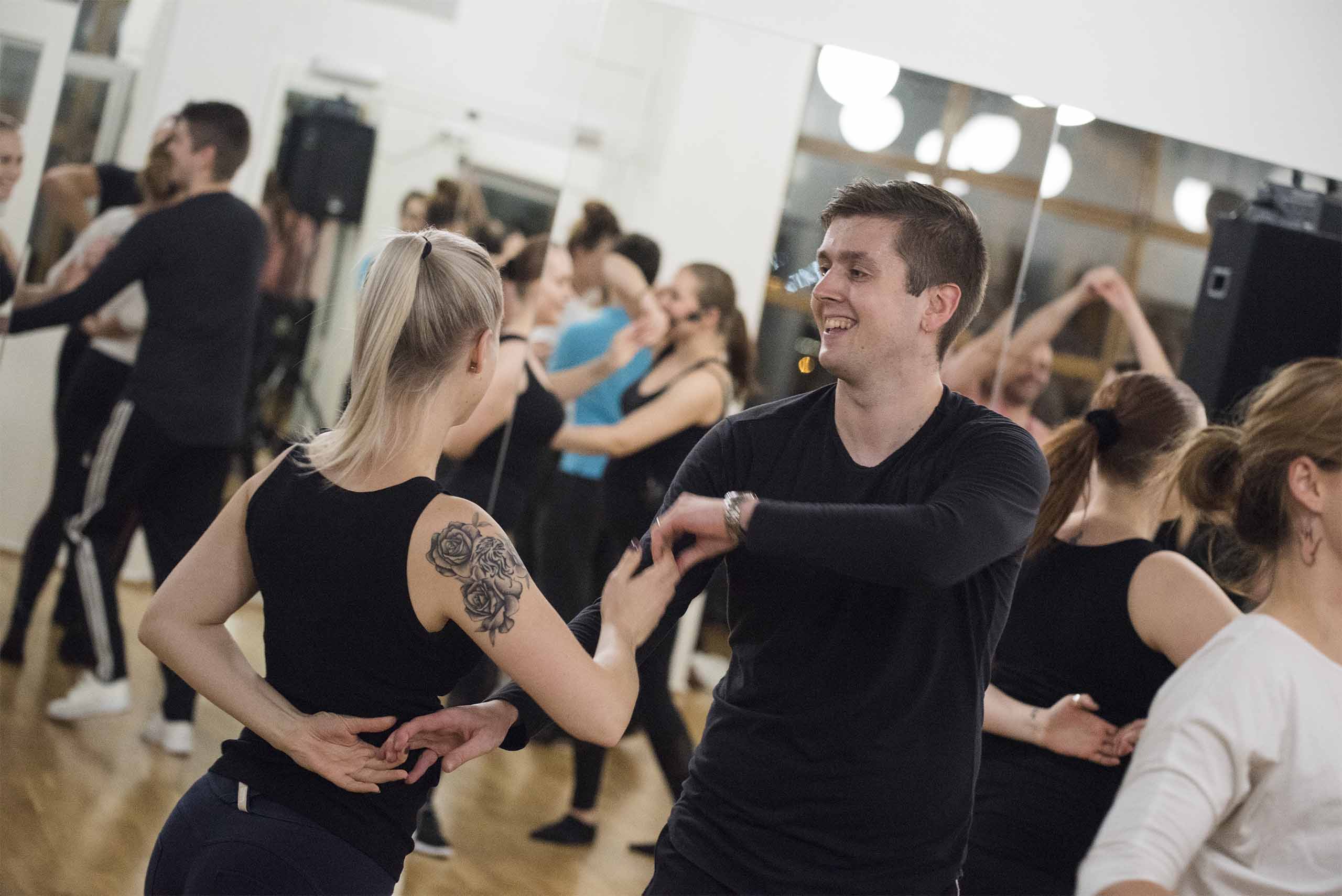
Flama’s couple salsa classes are all Cuban style. Cuban couple salsa is an energetic and joyful social dance. In the classes, you will learn the rhythms, steps, body movements, and styling of salsa, as well as the typical patterns used in Cuban salsa. A defining feature of Cuban salsa is its circular movement (as opposed to linear salsa, where the movement takes place mainly straight forward and backward along a line).
Cuban salsa is a social dance, meaning that it is danced freely with different partners, without any pre-arranged choreography. In class, students learn the skills of leading and following—that is, how dancers communicate through movement: the leader guides the dance through subtle body movements and hand signals, while the follower responds to them naturally. This allows for improvisation, being present in the moment, and dancing with anyone—even if you have never practised together before..
Cuban salsa is based in particularly on Cuban son: a music and dance style from the early 20th century that combines African rhythms (e.g., clave, call and response structure, percussion instruments) and Spanish melodic influences (e.g., guitars, singing). Cuban salsa is a rich mix of music and movement, with influences from Cuban rumba, mambo, cha-cha-chá, and other Cuban and Afro-Cuban rhythms and dances.
The call-and-response structure, a dialogue of invitation and response rooted in African tradition, is present in Cuban salsa through the rhythms of the music, the singing, and the playful, reactive dialogue between the dancers. Call and response originates in African musical traditions, where one person sings or plays a phrase (the call) and others answer (the response). This can be found throughout Afro-Cuban music, for example in son and rumba.
LEVEL DESCRIPTIONS:
The number of training years mentioned in the descriptions are indicative, because everyone develops in dancing individually and at their own pace. At the second and thirs level, we encourage you to stay for several seasons, since there are so many things to learn. If you are concerned about your own dance level, feel free to contact us and ask more: info@flama.fi. Rehearsing, repeating and practising the basics always improve your dance skills, so we recommend you to participate in courses lower than your actual level as well.
LEVEL 1 (new beginners)
This level starts from the very basics, so you do not need to have any previous dance experience. At this level, we learn basic techniques, the most common basic figures, and technique of leading and following. In addition, we get excited about the wonderful atmosphere of Cuban salsa in general!
LEVEL 1+ (0,5–1 years)
This level is ideal for those who know the basics of couple salsa and have attended classes weekly for about six months. The most common basics, such as enchufla, di le que no, di le que si, setenta, sacala and vacilala are already familiar to you. In this course, we continue with the basics as well as expand our knowledge by learning how to vary and combine the basics in new ways.
LEVEL 2 (1–2 years)
If you have been dancing couple salsa weekly for about a year, you are very familiar with the basics, and dancing is already going well with most dance partners, this is probably the right level for you. We deepen our skills from basic figures to slightly more challenging variations and figures. Besides, we will delve more into body movements.
LEVEL 3 (around 2–3 years)
The third level is suitable for those who have danced couple salsa weekly for about a couple of years. At this level, skills that we have become familiar with at the previous levels are deepened, varied and practiced. In addition, we will learn new figures and enhance the use of the body.
LEVEL 4 (around 2,5 + years)
This level is suitable for those who have danced couple salsa for several years. At this level, we deepen, vary, refine and practice figures that have already become familiar in previous levels. In addition, you learn new figures and body movements. At this level, the focus is more on music interpretation, styling and how to create a shared musical experience from dance.
Welcome to Flama to dance lively cha cha and wonderful ballroom rumba with the charismatic Valtteri Palin, known from the TV show Tanssii Tähtien Kanssa!